Origin Story: How Sensory Interior Design Evolved through Art, Massage and Neuroscience
Veronica often cried during her massage. She couldn’t tell me why. She would get on my table and the tears would start flowing, soaking through the face cradle cover and dripping onto the carpet. I was careful to have a full box of tissues handy.
Holding space for tough emotions is part of the job description for any massage therapist. Neurologically speaking, emotions are a physical manifestation of a learning process; they’re a huge part of how we make sense of our experience. A massage studio is a safe place to allow those emotions to move through our bodies, if the massage therapist creates it to be.
When Veronica started coming for massage, I was recovering from a firestorm in my own life. During the previous twenty years, I was a globe-trotting professional artist—the kind without a trust fund or a wealthy spouse. I got my furniture out of dumpsters, founded ‘alternative’ art spaces in San Francisco and New York, designed my own residency in Mexico, made art full time and accepted just enough massage clients to keep the lights on.
At the start of the Great Recession, my child was born and their father became semi-permanently unemployed. Art did not provide. In 2010 we left New York for my mother-in-law’s Philadelphia basement, and massage became my full-time business.
Then in 2012, Veronica told me she loved the way my massage studio was set up—particularly the blue mandala over the table—and asked if I would paint her staircase risers. I said no. I was done with art.
“I’ll write you a check for a deposit,” she insisted. I said okay.
Veronica had a vision: “I want the living room to feel like it’s under water.” She had picked several shades of blue and teal for the walls, and she wanted the three-story row house to shift from blue to teal to yellow as you ascended the stairs. “Done,” I said. Over the next few weeks we created a studio salon in her living room; as we worked we swapped stories, listened to music, drank wine, and discussed the progress of her stairs, just as artists have done for generations.
It was joyous.
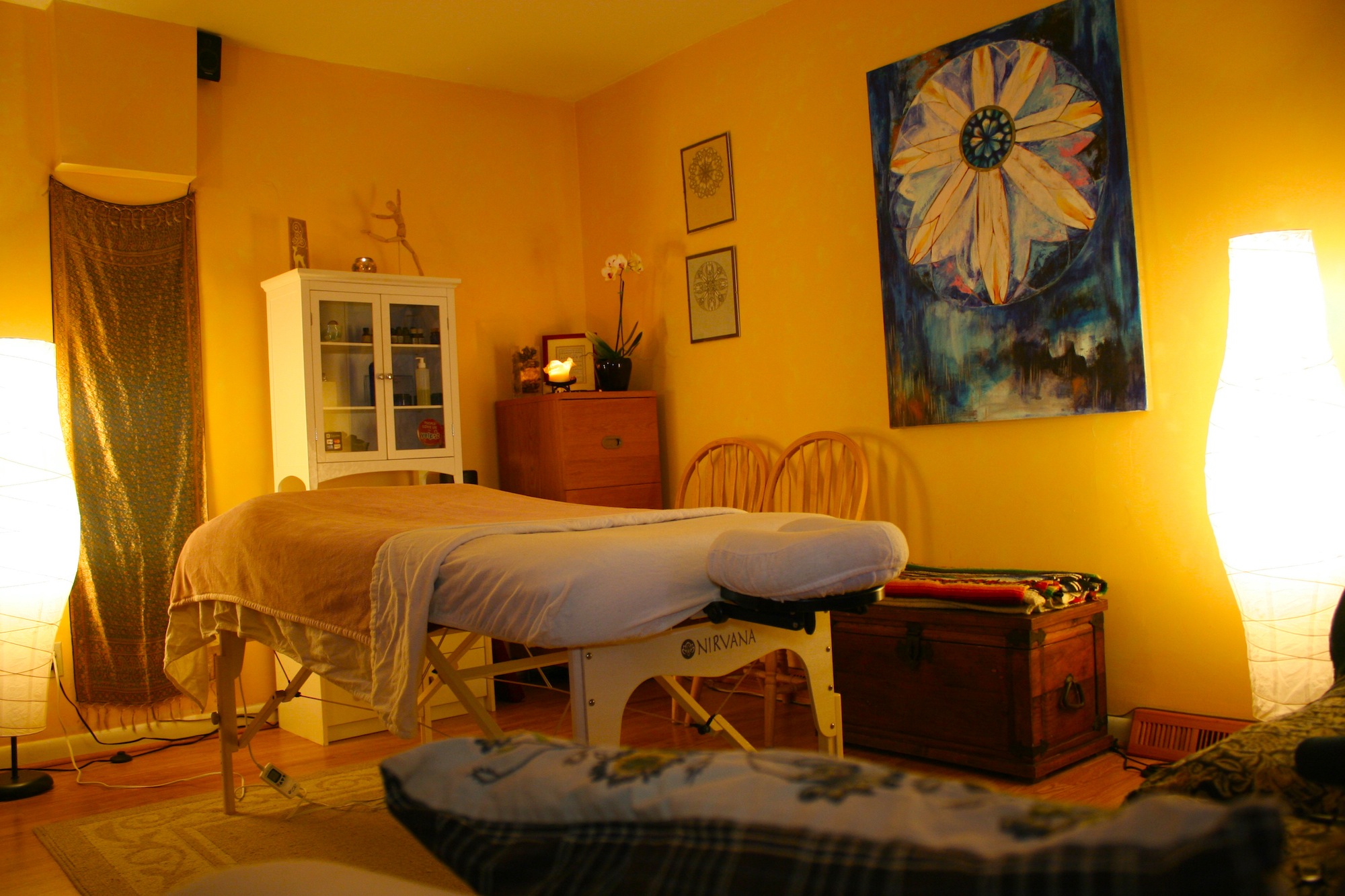
The massage studio which sparked Sensory Interior Design.
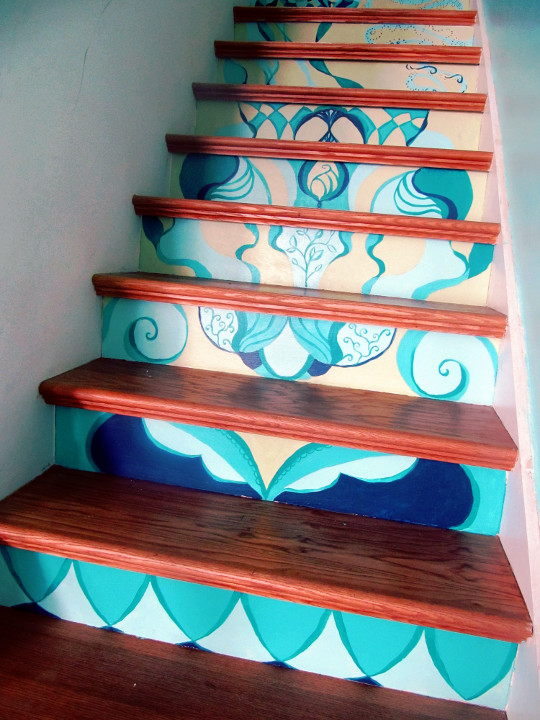
The risers Veronica conceived and Stephanie created.
A Transformative Art Experience
Research tells us that when we spend money on experiences, they bring us more lasting joy than simply buying objects. (Van Boven & Gilovich, “To Do or to Have? That Is the Question,” Journal of Personality and Social Psychology, 2003.) An adventure, a class, a project or a retreat connects us with others, forms our sense of identity, and resists social comparisons—our adventure is not like anyone else’s.
Veronica didn’t commission an art object. She and I co-created an art experience. For years afterward, she referred to her stairs as “the soul of the house.” Our collaboration sent both our lives in new and healing directions. She moved through her ambiguous grief, accepted a commission to Puerto Rico, met the love of her life, started a family, and discovered a passion for narrating audio books (and is currently working on mine.)
I founded Practical Sanctuary. Working with Veronica showed me what my painting career had lacked—meaningful personal connection. Instead of working alone in my studio, creating objects without homes, I re-dedicated my hard-earned design skills to the service of specific people.
From the very beginning, Practical Sanctuary focused on interior design as a collaborative experience, not a traditional commercial service. This wasn’t conscious planning, but an organic extension of my values. I’d never organized my life around buying expensive stuff—how could I earn a living by selling it?
Everything Useful Can Also Be Beautiful
The great designer William Morris said that good design means “having nothing in your home which you do not know to be useful or believe to be beautiful.” A Practical Sanctuary design principle is that everything useful can also be beautiful, as long as it is framed correctly. Over the next few years, my massage practice extended into a design practice centered around healing environments, among them a private physical therapy gym and a personal training studio.
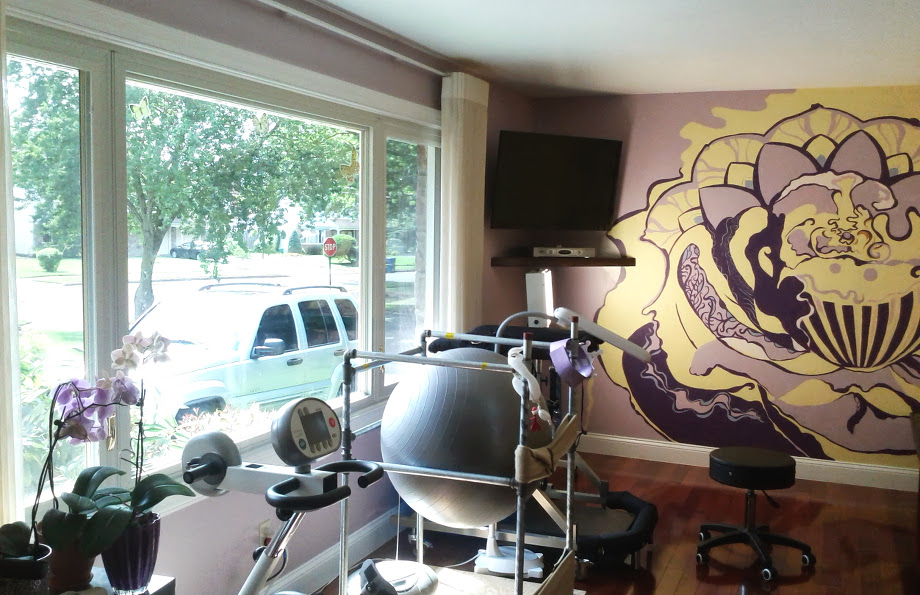
Lotus mural in physical therapy gym provides light and inspiration for Maria as she regains function after a debilitating stroke.
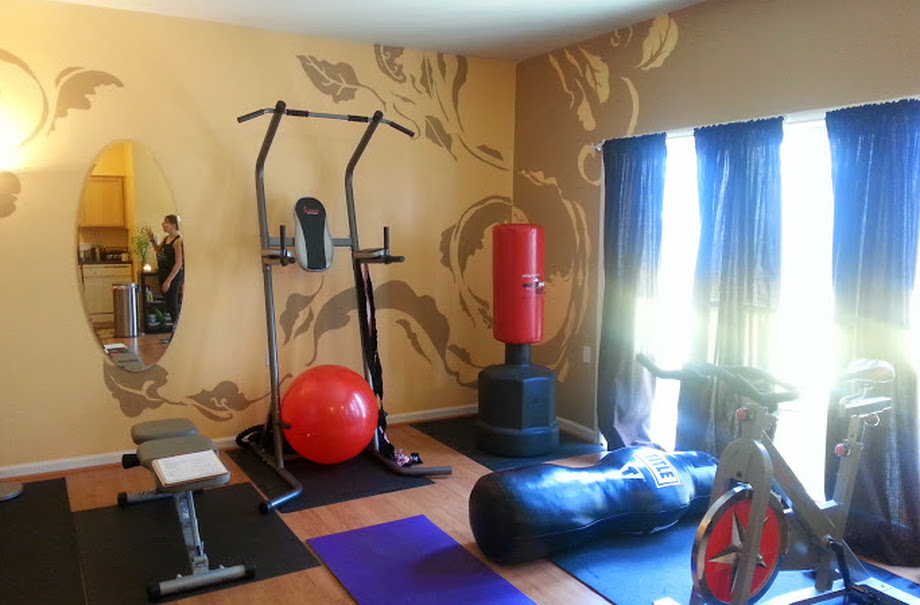
In the gyms we create, the equipment acts as both sculpture and playground. It invites you to play, instead of taking up space with implied obligation.
Neurodiversity Enters the Chat
At the end of 2013, my beloved brother-in-law, the architect Leif Weaver, passed away from a rare form of lymphoma. Toward the end of his life we came to understand that much of his genius stemmed from his neurodivergence—and his architecture career was profoundly informed by this.
After he passed, my sister and I collaborated to complete the house in Maine he designed and built. This was better training in Sensory Interior Design than any academic program, given that such a program did not yet exist. Not only did Leif design the house to support the way his nervous system processed information, but to reflect his study of permaculture and sustainability.

Finishing the Leif Weaver House in Brooks, Maine was an invaluable master class in designing for neurodiversity.

Niche in Weaver home, featuring Moroccan lamp, architectural drawing, built-in cat door.

Permaculture ready; Enclosed porch over ground floor tool shed, three stories of south-facing windows for winter solar gain, covered walkway which keeps off snow.
Space Therapy: Healing With Design
With every new project, I was able to distill more elements of what became the Space Therapy framework. The proposition felt deceptively simple: your space can be an instrument of healing. It can help to restore your health, your relationships, your community and the natural environment.
This is true no matter who or where you are. It’s true in your home and your business, in hospitals, schools and campgrounds. You don’t need a huge budget to start. You can start right here, right now, with what you have.
The Eccentric Genius Habitat Intervention
Free E-course
Your space, your nervous system.
Most of us were never taught how our bodies actually experience a room–the light, the sound, the layout, the smell–and what happens when those things work against us rather than for us.
This free seven-day course is a gentle introduction to sensory design. Each day brings one small exercise–noticing your senses, photographing what you’ve been editing out, dreaming about what you actually want. The exercises are all optional, and you can go as deep as you like.
By the end, you’ll understand why certain places drain you, what your body is telling you, and how to start without overwhelm.
Sign up below. Your first email arrives within the hour.
Space Therapy Q & A
$49 for 45 minutes
You know something isn’t working. You might even know what it is. What you need is someone who can look at your specific situation, ask the right questions, and give you a clear direction.
This is a single focused conversation–by video or phone, remote or in person. We’ll identify your most pressing design problem, talk through what’s underneath it, and map out what a real solution looks like.
You’ll leave with clarity about where to start, and what working together could look like if you want to go further.