Developed by Stephanie Lee Jackson for Practical Sanctuary, 2025
Brian came to Practical Sanctuary with a heroic list of self-help practices. He was immersed in trauma therapy for PTSD; tweaking medications; working with mindset, mindfulness, and community. Amid all this was a home that “felt like a sinking ship.”
His theory about his space was that he “missed the design gene.” He blamed himself for the mess and the chaos. Someday, when he was finally healed, he’d get around to fixing the space.
He had it backward.
He had been doing the work alone — relying entirely on his own brain to regulate, to cope, to remember the right actions under maximum stress.
This is an impossible ask. Your nervous system was not built to operate flawlessly in a vacuum, let alone in hostile territory. The place you live can be your ally — structural, immersive, and precisely attuned to who you are.
Space Therapy is a sensory interior design practice developed by Stephanie Lee Jackson, founder of Practical Sanctuary, for people who are overloaded — by health, work, family, and a nervous system that’s working overtime. It combines an understanding of art, design, curation and somatic healing with cutting-edge neuroscience. We collaborate with you to reduce your environmental load — the sensory and emotional stressors which drain your physical energy and mental focus — while creating a space that’s truly supportive.
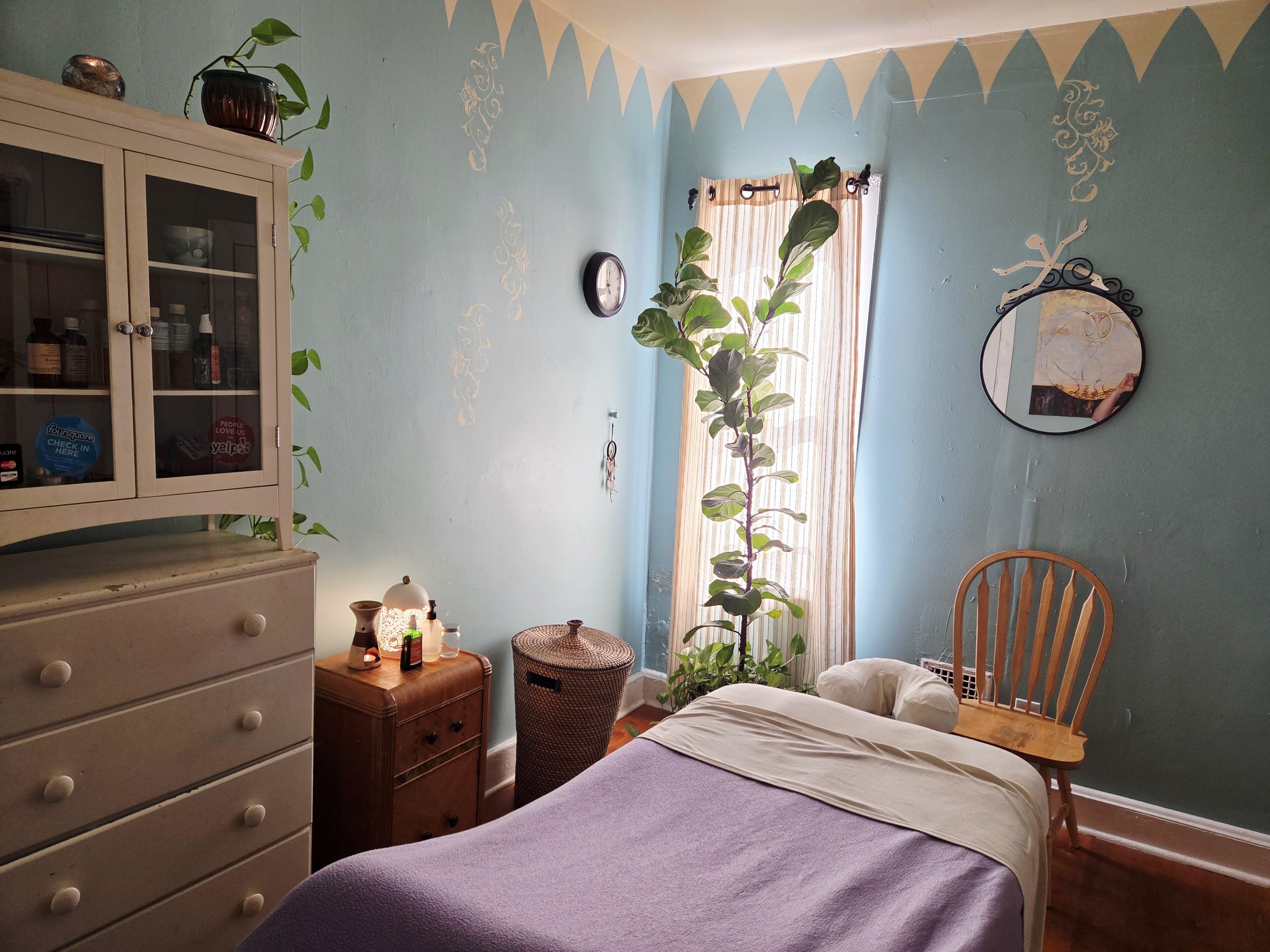
Massage therapy treatment room with biophilic and sensory interior design elements. Clients call it 'the room that does the thing.'
Designing For Your Needs
Most of us were taught, explicitly or otherwise, that comfort is a reward. That a beautiful, functional home is something you earn — after the promotion, after the kids are grown, after you’ve finally gotten yourself together. Until then, you make do.
Not only does this myth fail to serve you, it gets in the way of your promotion.
Your needs are not negotiable. Not because you have earned them, but because they are yours. The home that supports your nervous system is not a luxury you work toward. It is the ground you stand on while you do the work.
Environmental Load
Environmental load is a term developed by Stephanie Lee Jackson at Practical Sanctuary to describe the cumulative sensory and emotional triggers a space adds to an already overstretched nervous system.
Every space has a design, whether it was chosen intentionally or inherited by default. Default design is almost never attuned to you.
Some common ways a space generates environmental load:
Acoustic chaos. Sound is the most underestimated variable in interior design. Hard surfaces, open layouts, and ambient noise from neighbors, traffic, and appliances create a constant barrage that triggers fight-or-flight responses in your nervous system, drains your focus, and physically exhausts you — and you might not even notice what kind of strain that puts on you until it’s gone.
Harsh or poorly placed lighting. Light is not neutral. The wrong color temperature, intensity, frequency or placement can cause eyestrain, headaches, and migraines. It disrupts your circadian rhythms, degrading your sleep and your mood. For people with visual sensitivities, some types of fixtures can trigger auras or seizures. Fluorescent lights are the worst culprit, emitting a frequency that causes real neurological distress for many neurodivergent people. Most default lighting prioritizes unfiltered overhead fixtures that flatten a room and fatigue the eyes — the opposite of what a nervous system under load needs.
Inefficient layouts. Many people assume they lack enough space to pursue their passions, whether they be woodworking, daily yoga, or entertaining forty people every weekend. They almost never do. Usually they’re living with a layout that was not designed for their priorities.
Default layouts attract default decisions — the dining room that you dine in once a year, the sunny spare bedroom that rarely hosts a guest while you work from a corner of the basement. Meanwhile your passion projects lack a dedicated home. In shared spaces, blurred spatial boundaries can erode your privacy and your agency.
An intentional layout does not require more square footage. You can find the space for what you love, as long as you’re clear about what your spatial priorities are.
Unnecessary clutter. Clutter is not just mess. Every object in your space makes a demand on your attention, whether you notice it or not. The cumulative weight of unresolved objects — things without homes, tasks without completion, purchases without purpose — adds a continuous low-grade stress to your nervous system that compounds over time.
However, not all visible storage is clutter. Many people with ADHD need to see their belongings in order to remember they exist. Out of sight genuinely means out of mind, and a system that hides everything is a system that works against your brain.
The goal is not a pristine room. The goal is a space where every visible object is there by design. According to William Morris, good design means “having nothing in your home which you do not know to be useful or believe to be beautiful.” At Practical Sanctuary, we believe that everything useful can also be beautiful.
Misattuned color and visual narrative. Color is more than decoration; it is physics and physiology. Color filters through your memory and your temperament to evoke specific emotions. It shifts radically with the light. Colors change with time of year, window size, cardinal direction, and ceiling height.
Default color palettes are chosen for mass appeal and photographed under controlled conditions. They are almost never attuned to your nervous system, your personality, or your light.
Visual narrative — the story your space tells through its objects, art, and arrangements — operates the same way. A space without visual curation generates visual noise, which increases environmental load. Curation amplifies your natural taste by intentional placement, attuning all visual cues to your preferred frequency.
Environmental Lift
Environmental lift is a term developed by Stephanie Lee Jackson at Practical Sanctuary to define a space that actively supports your mood, memory, and healthy behaviors through intentional design decisions.
Environmental lift is not just an aesthetic upgrade; it is a functional one. When your space stops fighting your nervous system and starts supporting it, the resources you spend on managing your environment are freed up for everything else — your work, your relationships, your health, your rest. The space does not solve your problems. It stops creating them.
Brian’s home is not finished. It may never be — spaces evolve as people do. What has changed is that he is no longer doing the work alone. His environment participates in his recovery rather than blocking it, giving him room to breathe. He says, “I may not have been born with style and flair, but now I can listen to my instinct and heart and translate it into action that creates beautiful spaces for living and working.”
He came to Practical Sanctuary believing he had missed a gene. What he had missed was a space attuned to who he is.
Space Therapy: Core Principles
Here are the beliefs that will drive every engagement you have with Practical Sanctuary:
Your Needs Are Not Negotiable.
In many households, one person may sacrifice their needs for the system. This is particularly true for caregivers, who are often running on empty while keeping everyone else’s tank full. Rest, quiet, exercise, the projects that make life worth living — these get deferred, compressed, or abandoned entirely. This is not sustainable. When a caregiver collapses, the whole system fails.
Getting your needs met is not a reward for perfect behavior. Your needs are the foundation of a thriving household. Physical safety, emotional safety, rest, movement, time and space for the things you love — these are not luxuries. They are the load-bearing walls of a functioning life.
Assume There Is a Solution.
The biggest barrier to solving a problem: deciding it cannot be solved. We fail to address 100% of the problems we don’t acknowledge, and we fail to solve 100% of the problems we assume are unsolvable. Both of these are decisions, conscious or not.
What this looks like in practice: clients declare that they don’t have the time, space, money or bandwidth to do the thing they want or need. After going through their space, possessions, budget and timeline with a ruler, a layout app, and some creative ingenuity, we find what they need to do the thing. Nearly every time.
The solution is rarely what they expect. It is almost always within reach.
Your Body Knows the Truth.
The design process should bring joy, at least some of the time. If it doesn’t, something needs to change. Pain is not a random mood — it is a diagnostic signal.
Your emotions are not separate from physical sensation. When you pay attention to how your body responds to a design decision — a color palette, a furniture arrangement, a piece of art — you get more accurate information than any list of pros and cons will give you.
Your brain tracks and filters millions of data points on a subconscious level, and serves them up to your conscious mind in the most efficient way possible — a sinking feeling in your gut, an expansion in your chest. The Space Therapy design process is, in part, an exercise in learning to trust that information.
This is particularly important for people who have learned, through painful experience, to override their own instincts. Rebuilding that trust takes time and support. We build that support into every step of the process — not just the end result.
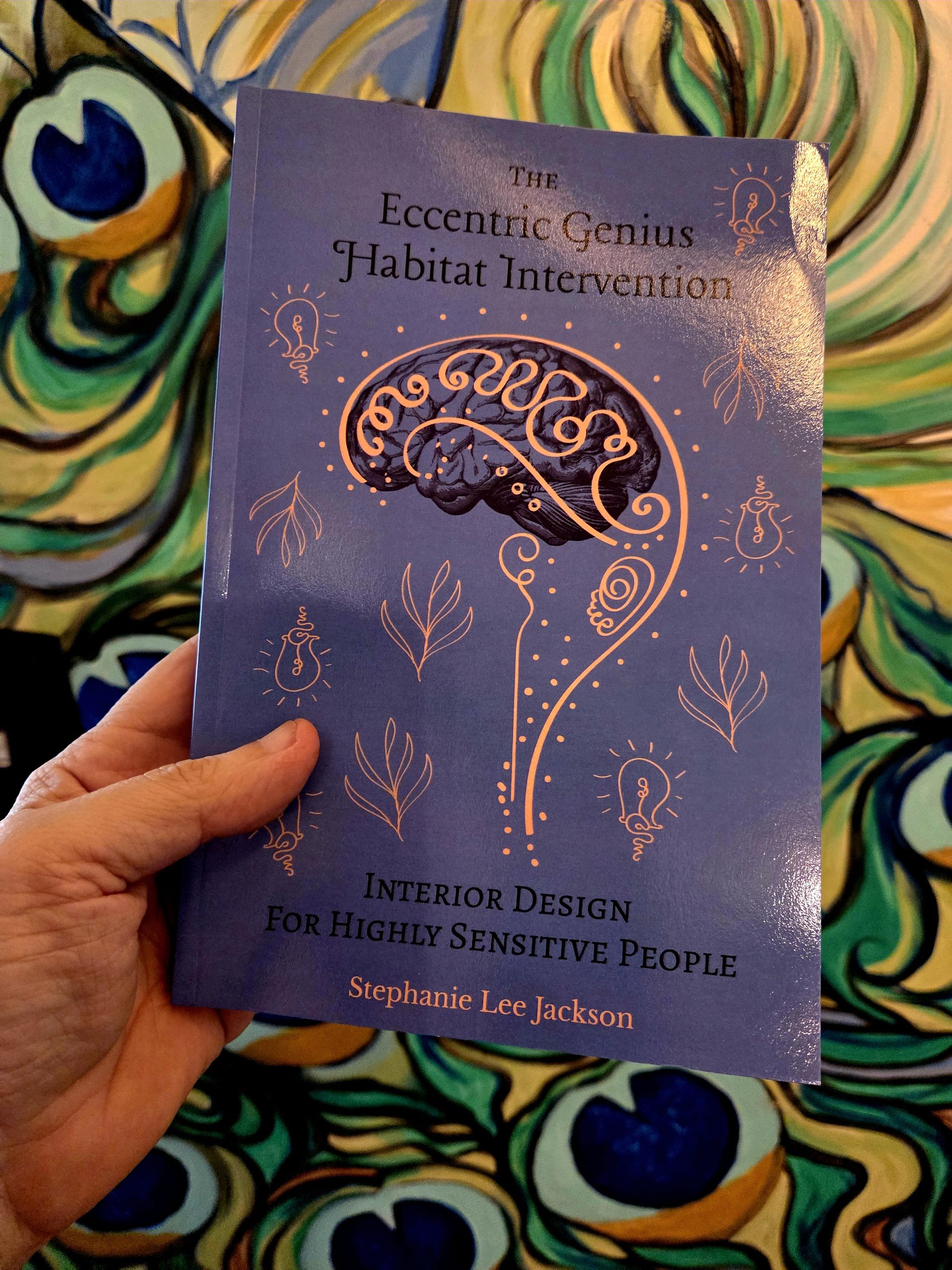
For a detailed guide to understanding your nervous system, identifying and solving design problems, see Stephanie’s book, The Eccentric Genius Habitat Intervention: Interior Design for Highly Sensitive People. Available in e-book and paperback.
“I was in a slump with my surroundings because I was beginning to feel that yeah it’s nice and all but what’s the point? This book gives you the reminders that help you remember the point. If I quoted all of my favorite impactful parts of the book, I’d be breaking some kind of copyright laws with the amount alone. Thank you for writing this highly motivating, poignant, validating book. It will be a staple reference book for both my personal and professional life.” –B.R., Amazon review
The Space Therapy Diagnostic Framework
Stephanie Lee Jackson developed Space Therapy after spending years working at the intersection of bodies and spaces — first as a massage therapist learning how physical environments affect the nervous system, then as a fine artist and gallery director learning how objects, colors and layouts charge a room. What she kept seeing, in both worlds, was people doing enormous personal work — therapy, mindfulness, medication, community — while living in spaces that were actively working against them. She founded Practical Sanctuary when those insights converged into a practice: helping overwhelmed people reduce the environmental load their spaces create, so their home can be a reflection of the life they’re trying to lead.
Step 1: Identify Your Real Needs and Goals
When you come to Practical Sanctuary, we never assume we know what your needs are until we have determined exactly what you’re struggling with, what your priorities are, and where you’re stuck. We’ll ask you to take us on a tour of your space, virtually or in person, and ask questions. “Tell me about this area, object, decision. What’s the story behind it? What’s working and what isn’t? How do you feel about that?”
Once we have been through this first diagnostic pass, we identify your underlying set of specific goals, and the reasons for selecting those goals. We check in with you to make sure we are on the same page, and give you a chance to add or change anything that doesn’t feel right.
We don’t want you buying that $5K couch until we’re sure it’s the best way to invest your budget.
Step 2: Establish Boundaries
One of the most common problems we see in working with families and companies is blurry or nonexistent physical boundaries that make it difficult for everyone to get their real needs met. A parent who works from home lacks an office with a door they can close, shutting out noise and interruptions. Craft projects and paperwork flood the dining room table. Laundry takes over the living room. Exercise equipment blocks library access, and none of it is ever used.
These failures of boundaries are not failures of character. Defining spaces with intention can free up a lot of physical and emotional bandwidth for handling routine aspects of daily life. When we clarify what each space is for and set it up to support that function, problems that seemed intractable can dissolve overnight.
Step 3: Tackle High ROI Interventions First.
Once we have identified goals and established boundaries, it’s easier to decide where to start. A high priority intervention might be anything—decluttering, acoustic baffling, lighting, color or layout. It might not even be the issue you originally came to us for. It will be something we surfaced together during diagnostics, and it will fundamentally change the way you interact with your space.
When you’re making changes to your space, one shift will determine many other decisions. Trying to do everything at once is guaranteed to create overwhelm and decision fatigue. Picking a high priority first step makes every subsequent decision easier and more fun.
Step 4: Build Aesthetics Around Your Values.
Some of our clients have been burned by previous battles with interior designers, who made unilateral design decisions and then offered to ‘explain why it works.’ Usually these decisions involved the client forking over a hefty commission on objects they didn’t want or need.
Not at Practical Sanctuary.
By nature, interior designers can be very opinionated about aesthetics. Our opinions do not give us the right to override your judgment. We are not living inside your home or your nervous system. (See Core Principle #3: Your body knows the truth.) What’s important is how you feel around a certain color, art object, style, or theme.
Your space is constantly sending cues to your subconscious mind about who you are, what you are working toward, where you have been. The space around you works on a physical level (light, acoustics, texture, function), emotional level (color, narrative), and even a spiritual one (ancestry, community). All of these levels must work together to tell a coherent story that nurtures your unique nervous system.
You are the person who informs and determines these cues. Not a designer’s ego.
Where art and design experience comes in handy is in analyzing the physics of your choices in an aesthetic context. This helps us referee differences of aesthetic opinion among family members. Breaking down a choice in terms of value, hue, style, composition and narrative association gives you something clearer to discuss than “I just don’t like it.”
What this looks like in practice: Elizabeth loves a brightly colored area rug; her partner Sam isn’t sure about it. They ask if it will work in their living room.
Designer’s response: it doesn’t necessarily clash, but how does everyone feel about magenta?
Sam is not fond of magenta. Since it’s a common room, Sam gets veto power. (See Core principle #1: Everyone’s needs matter equally.) We find another rug with similar energy, in colors that everyone likes. Elizabeth gets a magenta rug for her office.
We don’t see your design as a blank canvas to be filled with a signature style. We see it as an organic blossoming of seeds that already exist within you.
Step 5: Build Evergreen Design Structures
Your design process is never one and done. As we work together, we create systems for making design decisions that you can return to again and again. Your interactive albums, personalized plans, processes and style preferences live in the cloud for you to refer to whenever you need to make a change, want to add a new element, expand or downsize.
We have clients who have made multiple international moves since we first began working together. With every move, they become more confident about making decisions, less stressed about the moving process, and more comfortable in each new home—even if it’s a 6 week rental in New Zealand.
Our intention is not to keep collecting a percentage of each new redecoration. It’s to provide the lifelong joy of feeling at home in your habitat, and enjoying every step of the process.
Where to Begin
If you are interested in learning more, we offer low-risk ways to get started.
Our free e-course is designed to help you identify the specific ways your space may be working against you, and begin making changes right away.
If you would like direct guidance, a $49 Space Therapy Q&A gives you an hour with Stephanie to diagnose your most pressing environmental load problems and map a realistic path forward.
Your space is not waiting for you to be ready. It is ready for you now.
The Eccentric Genius Habitat Intervention
Free E-course
Your space, your nervous system.
Most of us were never taught how our bodies actually experience a room–the light, the sound, the layout, the smell–and what happens when those things work against us rather than for us.
This free seven-day course is a gentle introduction to sensory design. Each day brings one small exercise–noticing your senses, photographing what you’ve been editing out, dreaming about what you actually want. The exercises are all optional, and you can go as deep as you like.
By the end, you’ll understand why certain places drain you, what your body is telling you, and how to start without overwhelm.
Sign up below. Your first email arrives within the hour.
Space Therapy Q & A
$49 for 45 minutes
You know something isn’t working. You might even know what it is. What you need is someone who can look at your specific situation, ask the right questions, and give you a clear direction.
This is a single focused conversation–by video or phone, remote or in person. We’ll identify your most pressing design problem, talk through what’s underneath it, and map out what a real solution looks like.
You’ll leave with clarity about where to start, and what working together could look like if you want to go further.