
Your Body Doesn’t Keep Score
Your body doesn’t store trauma, but with a little help from your space and your mind, it can help with trauma processing.
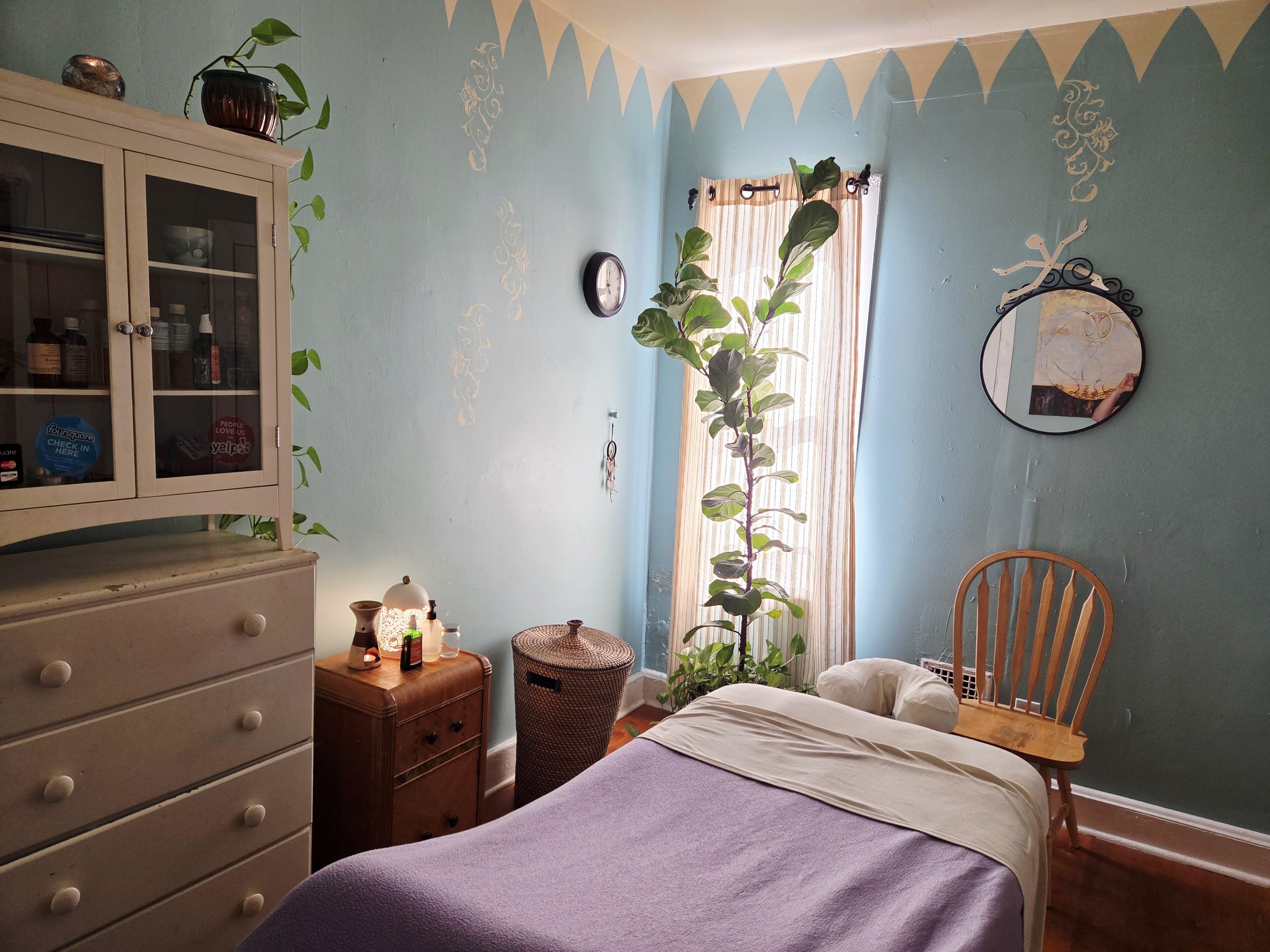
Massage therapy treatment room with biophilic and sensory interior design elements. Clients call it 'the room that does the thing.'
“The issues are in the tissues.” It feels so plausible: your body stores traumatic memories your brain can’t hold, until such time as you can safely ‘release’ them through yoga, massage, or other somatic therapy.
Too bad it’s not true.
Bessel van der Kolk’s book The Body Keeps the Score validated the intuition of millions, who had a sense that traumatic experience might be driving their mental and physical health problems, long after the fact. As Michael Hobbes and Peter Shamishiri explain in their fabulous podcast, If Books Could Kill, the book went viral over several years, entirely by word of mouth. Friends recommended it to friends, who were struggling and getting no help from doctors.
This was fair. Medical science took a long time to understand how trauma leads to illness. Back in 1998, the Adverse Childhood Experiences study showed that the more trauma a person sustains as a child, the greater the chances they will develop serious physical and mental illnesses as an adult. It took another decade or two for researchers to map the physiological pathways which turn mental suffering into physical illness.
Meanwhile, too many doctors dismissed too many symptoms as “it’s all in your head.” ‘The Body Keeps The Score’ told suffering people they weren’t crazy, and that helped.
However, van der Kolk relied on pseudoscience, debunked theories, and outright fabrication to reach many of his conclusions. Chief among those false conclusions was ‘talk therapy doesn’t heal PTSD, and yoga does.’
As a massage therapist and neuroscience nerd, I’ve marinated in tissues with issues for more than twenty years. It’s tempting to believe that I can ‘release trauma’ and heal my clients with my magical touch, but the truth is more complicated–and much more interesting.
The mechanics of how trauma affects the body has to do with the divisions of the autonomic nervous system–the vast amount of processing done by the brain without conscious direction. The autonomic nervous system has two settings: sympathetic (fight, flight, freeze, fawn) and parasympathetic (rest, digest, repair, procreate). They work on a toggle switch–only one or the other is engaged at any given time.
When trauma hijacks your autonomic nervous system, your brain gets locked in high alert. It robs your time and resources for rest, learning, healing, destroying pathogens and cancer cells. Over time this leads to systemic breakdown.
The reason it feels plausible that talking won’t heal trauma is that the autonomic nervous system is not conscious. You can’t override it by thinking.
That doesn’t mean you have no way to communicate with your unconscious mind. Your issues are not stored in your tissues, but your tissues are full of sensory receptors which communicate directly with your autonomic nervous system, bypassing your voluntary nervous system–in part or in full. That’s why deep tissue massage produces deep relaxation. Targeted pressure tells certain receptors to send a signal to the spinal cord, which responds with an order: “relax whole muscle.”
To take your brain out of high alert, you need to communicate one simple message to the autonomic nervous system: you are safe. There are as many ways to do that as there are stars in the universe. How you do it depends on where you put your attention.
Evidence shows that cognitive behavioral therapy is an effective treatment for PTSD, but it works less than half the time. EMDR, which combines talk therapy with sensory input, has proven to be as effective and often more efficient. A combination of conscious intention and somatic processing can help the brain rewire the pathways that scream “we’re under attack!” into a pattern of safety.
That conscious intention can extend to how you design your environment. Your nervous system is constantly picking up and filtering cues from your surroundings–the quality of light, the sounds, the odors, textures and cultural narratives. Many of those cues are processed below the level of your conscious awareness, but they are still affecting the state of your body and mind. Moreover, the way your space is designed can affect your behavior, tilting the balance toward healthy or unhealthy habits.
Your body won’t hold grudges if you give it some attention.

Share This Story, Choose Your Platform!

The Eccentric Genius Habitat Intervention
Your space, your nervous system.
Most of us were never taught how our bodies actually experience a room–the light, the sound, the layout, the smell–and what happens when those things work against us instead of for us.
This free seven-day course is a gentle introduction to sensory design. Each day brings one exercise–noticing what you feel, photographing what you’ve been editing out, dreaming about what you actually want. The exercises are all optional, and you can go as deep as you like.
By the end, you’ll understand more about why certain rooms drain you, what your body knows about your home, and how to start shifting without stressing out.
Sign up below. Your first email arrives within the hour.

Practical Sanctuary, sensory interior design, specializes in interior design for highly sensitive people.
We help you create spaces which are:

