Sensory Corner Ideas for Emotional Regulation at Home
Most homes already have a sensory corner. It just isn’t intentional.
If emotional meltdowns, shutdowns, or constant overwhelm keep happening in the same places, the issue usually isn’t behavior. It’s how the nervous system interacts with the environment. Light, sound, layout, and movement send signals to the body long before logic or coping strategies come online.
This is not a niche issue. According to the Centers for Disease Control and Prevention, nearly 20% of children in the United States experience a mental, emotional, developmental, or behavioral condition at some point during childhood. At the same time, research published by the National Institutes of Health shows that environmental sensory input; such as lighting, noise levels, and spatial layout, directly impacts stress response and emotional regulation.
This tells us something important: sensory regulation is not only psychological. It is environmental.
Reframing the Idea of a “Sensory Corner”
Most sensory corner advice focuses on tools, toys, or calming techniques. That approach can be helpful, but it is incomplete. Emotional regulation does not begin in a corner. It begins with how the body experiences space, sound, light, and movement throughout the home.
When sensory overwhelm shows up repeatedly, it is often a signal that the environment is asking too much of the nervous system. A sensory corner is not meant to fix a person. It is meant to reduce environmental strain.
What is a Sensory Corner?
A sensory corner is not a punishment space or a timeout zone. It is also not something reserved only for children. In our work, a sensory corner at home is a support zone for nervous system regulation. It is a place where the body can downshift without pressure, correction, or performance.
When designed well, a sensory corner communicates safety through predictability, reduced stimulation, and choice.
Why Emotional Regulation is Environmental
The nervous system responds before logic. It scans the environment for threats or safety long before we can reason our way into calm. When overwhelm shows up, it is often spatial rather than emotional.
Regulation improves when environments reduce sensory friction. That is why changing the space itself can be more effective than adding more coping strategies.
Why Traditional Calm-Down Corners Often Fall Short
Many families try calm-down corners and still feel stuck. That is not failure. It is usually a mismatch between the solution and the real problem.
The Problem With Tool-Only Solutions
When regulation depends primarily on tools, it becomes reactive. The child is expected to manage their response while the environment remains overwhelming. Over time, the same patterns repeat because the underlying sensory conditions never change.
In these cases, the corner becomes a recovery zone rather than a preventive one.
When Calm Becomes the Only Goal
Calm is often treated as the goal, but calm is not the same as safety. Quiet does not regulate every nervous system, and stillness can increase distress for people who regulate through movement or pressure.
For many neurodivergent nervous systems, being forced into quiet can actually heighten dysregulation rather than resolve it.
A Sensory-First Framework for Home Corners
At Practical Sanctuary, we design sensory corners as part of a larger system. They work best when they support the nervous system instead of trying to control behavior.
Principle One: Regulation Before Behavior
We always start by reducing sensory load. That means looking at light quality, sound levels, visual density, and spatial flow before adding any tools or techniques. If a space is too bright, too loud, or visually chaotic, no fidget or breathing exercise will fully compensate.
Environmental adjustments come first. Tools come second.
Principle Two: Choice Creates Safety
A sensory corner should never be forced. Language like “go calm down” activates the nervous system’s threat response and undermines regulation. When someone can choose when and how to use a space, their body is more likely to settle.
Autonomy is not optional. It is a core part of nervous system support.
Principle Three: One Home, Many Nervous Systems
Every household contains multiple sensory profiles. Children and adults often regulate differently, and shared spaces play a major role in overall stress levels. A sensory corner at home works best when the rest of the environment is not constantly dysregulating.
Sensory Corner Ideas That Actually Support Emotional Regulation
These sensory corner ideas at home focus on how the space feels, not how it looks. None require renovation, luxury products, or aesthetic perfection.
-
Location Matters More Than Objects
Where a sensory corner is placed often matters more than what goes inside it. Low-traffic areas reduce interruptions and surprise stimuli. Corners near busy hallways or televisions tend to increase dysregulation rather than reduce it.
Closets, alcoves, and side rooms often work well because they naturally limit sensory input and feel contained without being isolating.
-
Light That Soothes Instead of Stimulates
Harsh overhead or fluorescent lighting keeps the nervous system alert. Warm, indirect, or dimmable lighting supports regulation far more effectively. What matters most is control. When someone can adjust the lighting themselves, the nervous system relaxes more quickly.
-
Sound Buffering for Nervous System Relief
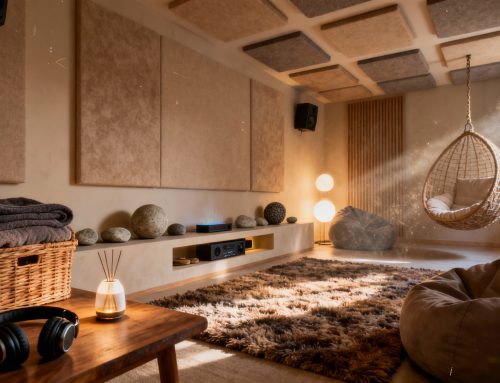
Noise is one of the fastest ways a nervous system gets pushed into overdrive. Not just loud sounds, but overlapping ones: voices, appliances, echo, background activity. Simple changes like rugs, curtains, cushions, or fabric on walls can soften how sound moves through a room and make it feel less sharp. Some people settle with steady background noise, others need quiet. There is no universal rule. What matters is how the sound lands in the body.
-
Grounding Through Texture and Pressure
Texture and pressure give the body something solid to register against. For some people, that looks like weight or firmness. For others, it’s consistency; knowing what a surface will feel like every time. Soft isn’t always calming, and more texture isn’t always better. The goal isn’t comfort in a generic sense. It’s helping the body feel oriented and held instead of on edge.
-
Movement-Friendly Options
Regulation doesn’t require sitting still. Many nervous systems settle through small, repetitive movement: rocking slightly, leaning, shifting weight, stretching. When a sensory space only allows stillness, it can actually increase tension. A supportive sensory corner leaves room for the body to move in ways that feel natural, without drawing attention or correction.
Sensory Corners for Different Nervous System Needs
There is no universal sensory corner. Regulation looks different across neurotypes, ages, and emotional histories.
-
For Highly Sensitive or Easily Overstimulated Nervous Systems
These nervous systems often benefit from lower visual density, predictable layouts, and gentle sensory input. Familiar items tend to feel safer than novelty. The goal is to reduce contrast and unpredictability.
-
For ADHD or Sensory-Seeking Profiles
Movement-based regulation is often essential. Resistance, pressure, and flexible positioning can help the body focus and settle. Expecting stillness can increase dysregulation rather than resolve it.
-
For Trauma-Sensitive Nervous Systems
Control is critical. The ability to enter and exit freely, avoid surprise stimuli, and maintain emotional safety matters more than visual order. A calm sensory space at home should never feel confining or restrictive.
Moving Beyond the Corner: Whole-Home Regulation
A sensory corner works best when it is not the only safe place in the house.
-
Why the Rest of the Home Still Matters
Kitchens, hallways, and living rooms shape daily stress patterns. If these spaces remain loud, bright, or chaotic, regulation requires constant retreat. Over time, this impacts family dynamics and increases burnout.
-
How Sensory Corners Fit Into Sensory Interior Design
In sensory interior design, corners are anchors, not fixes. Environmental patterns matter more than zones. When environments are designed preventively, emotional escalation decreases naturally.
Common Mistakes to Avoid
Even well-intentioned sensory corners can increase overwhelm when nervous system needs are misunderstood. Most issues come from treating regulation as behavior management instead of environmental support.
-
Mistaking Calm for Compliance
Quiet behavior does not always mean regulation. Some children appear calm because they are shutting down or masking distress. True regulation includes safety, flexibility, and ease, not just the absence of visible emotion.
-
Overloading the Space With Tools
Filling a sensory corner with too many items can overwhelm the nervous system further. Visual clutter and constant novelty often make it harder to settle. Fewer, well-matched supports tend to be more effective.
-
Using the Space as Behavioral Control
A sensory corner should never be used as a punishment or correction tool. When a space is associated with discipline, it loses its ability to regulate and instead increases stress.
-
Ignoring Adult Sensory Needs
Sensory regulation does not stop with children. When adult sensory needs are ignored, the overall environment stays tense. A regulated home considers every nervous system in the space.
Built For Real Nervous Systems
A sensory corner isn’t about calming children down. It’s about noticing where overwhelm begins and adjusting the environment so the nervous system doesn’t have to work so hard.
At Practical Sanctuary, we help families understand how their homes are actually being experienced day to day. We focus on practical, low-cost changes that bring more ease into shared spaces, without renovations, luxury spending, or pressure to make things look a certain way. If your home feels loud, tense, or draining, it’s not a personal failure. It’s information. Sensory consulting can help you understand what’s happening and how to support regulation more effectively.
Explore sensory consulting at Practical Sanctuary and begin shaping a home that supports the people living in it.
Frequently Asked Questions
What is a sensory corner at home?
A sensory corner is a designated space designed to support emotional regulation by reducing sensory overload and helping the nervous system reset safely.
Are sensory corners only for autistic children?
No. Sensory corners support anyone who experiences overwhelm, stress, or difficulty regulating emotions, including adults and neurotypical family members.
Do sensory corners require special equipment?
No. Many effective sensory corners use items already in the home. Regulation depends more on sensory alignment than on products.
Can adults use sensory corners?
Yes. Sensory regulation is not age-specific. Adults benefit just as much from supportive sensory environments.
When should families seek sensory consulting?
If overwhelm continues despite changes, or if multiple family members struggle in shared spaces, consulting can help identify systemic sensory issues.

Stephanie Lee Jackson is the owner and founder of Practical Sanctuary, Sensory Interior Design.
Practical Sanctuary uses trauma-informed neuroscience to create spaces that help you focus, heal, emotionally regulate, and build community. Clients call it ‘space therapy.’
As a professional fine artist, Stephanie founded art spaces in New York and San Francisco, exhibiting her paintings internationally. As a massage therapist, she founded Practical Bodywork in Philadelphia, and taught Anatomy, Physiology, Pathology, and Advanced Massage Technique at Community College of Philadelphia.
Her book, The Eccentric Genius Habitat Intervention: Interior Design For Highly Sensitive People is both a manifesto on the need for sensory accessible, sustainable design, and a how-to manual for creating spaces that are tailored to your unique sensory needs.
Share This Story, Choose Your Platform!

Are you an eccentric genius?
You’re in the right place, darling.
In this free e-course, you will discover:
The ONE design mistake that NEARLY ALL HUMANS make in their habitats, and how to fix it in 15 minutes. (You will roll your eyes. And cry.)
Three senses your kindergarten teacher didn’t mention. (And how they make you a NINJA.)
The design trend which created an epidemic of shut-ins. (NOT COVID-19. Some of us now know the meaning of schadenfreude.)
Why Febreze is EVIL. (There should be a warning label.)
What kinds of light fixtures will be BANNED when the establishment comes to its senses.
What color has to do with hormones. (And how to leverage it–St. John’s Wort, piffle!)
What NEVER to do, ever ever, if you do not wish to induce psychosis, extreme depression, vertigo, or actual regurgitation in guests and members of your own family. (We all love those Bad Examples.)

Practical Sanctuary, sensory interior design, specializes in interior design for highly sensitive people.
We help you create spaces which are: