What Is a Liminal Space?
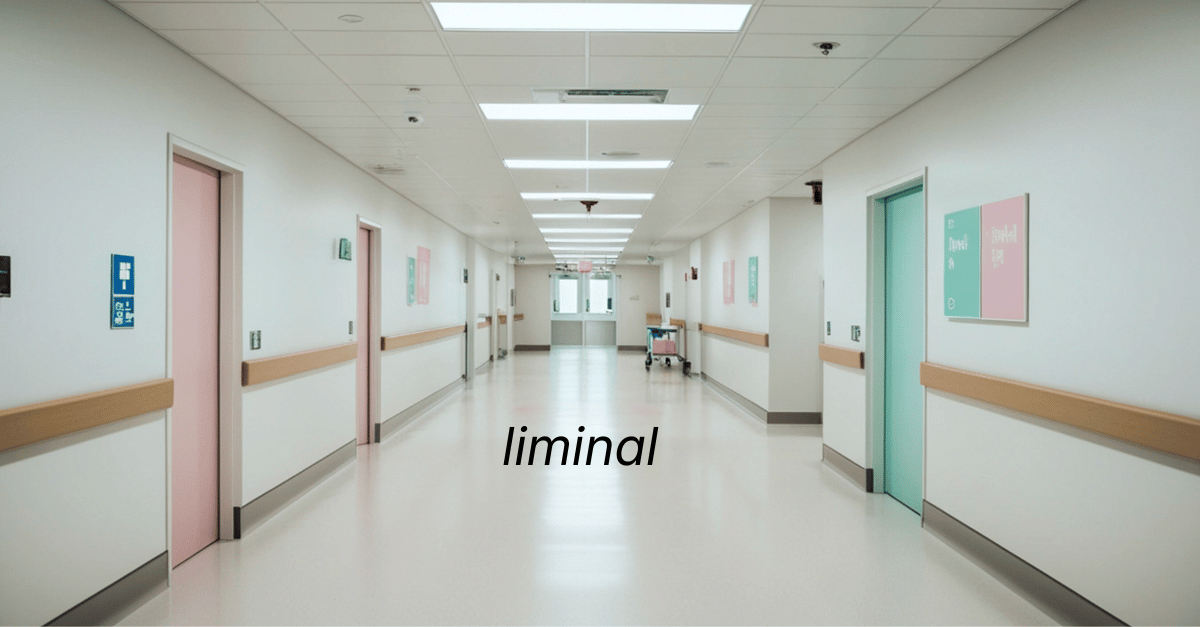
My kid pipes up at the oddest times. She doesn’t hang out on interior design blogs, but the language seeps through somehow. Once when I was hanging a(nother) bunch of dying roses upside down to dry them, she remarked that the kitchen was getting all ‘cottagecore.’ When we’re on a rare journey through a suburb, she throws the word ‘liminal’ around a lot.
Apparently, ‘liminal spaces’ are a meme. The word ‘liminal’ means ‘on a boundary; in transition between one place and the next.’ Liminal memes feature empty train stations, hallways devoid of identifying characteristics, malls, and any featureless space that exudes a sense of anomie.
They’re creepy because they’re lifeless. They could be anywhere and nowhere. And they remind me of what James Howard Kunstler calls “the ghastly tragedy of the suburbs: places that are not worth caring about.”
Epidemic of Dislocation
This got me thinking about how billions of people are living more and more of our social lives online. We’re becoming increasingly dislocated in our mental and emotional spaces. This is producing a loneliness epidemic that constitutes a health emergency, according to the U.S. Surgeon General. Humans are herd animals, and loneliness and isolation pose serious threats to our physical and mental health. Rates of heart disease, diabetes, stroke, depression and dementia are all closely tied to social isolation, and these have all been on a steady upward trend since 1976.
When we live and work in physical environments which reflect this sense of dislocation, we’re really in trouble. In order to be affordable, architecture and interior design is giving us cookie-cutter and bland.

Cookie Cutter Condos
Is it a development, or is it office equipment?
What Makes a Place Worth Caring About?
Architectural and interior design developments which nourish the human body and spirit communicate their ‘place-ness’ so:
- Landscape. They have a climate, a quality of light based on latitude and longitude, local flora and fauna, local terrain. Hills, plains, forest, beach.
- History. Their structures tell a story of human culture through architecture and aesthetic narrative.
- Community. There are places to gather, trade, communicate and collaborate with neighbors–parks, plazas, sidewalks, meeting places.
- Personality. Individuals can cultivate their own spaces with color, art, tools, textures, and activities.

Philadelphia Alley
Queen Village in Philadelphia: climate, history, personality, community.
How To Afford It?
Increasingly, wise people like my kid are deleting their social media and getting grounded in their physical places. We’re creatures, not brains in jars, and we need a healthy habitat.
But walkable neighborhoods with charming architecture, community engagement and a sense of rootedness in history are so appealing that most people get priced out of them. How can you bring this sense of place to your affordable home through interior design, wherever you are?
That’s what I wrote a book about. Taking your space from liminal to rooted involves a simple set of steps that start with observing and appreciating your own stories, landscape and community. You can bring your own unique genius to wherever you are–even if you can’t afford a historic Queen Village row home.

Stephanie Lee Jackson is the owner and founder of Practical Sanctuary, Sensory Interior Design.
Practical Sanctuary uses trauma-informed neuroscience to create spaces that help you focus, heal, emotionally regulate, and build community. Clients call it ‘space therapy.’
As a professional fine artist, Stephanie founded art spaces in New York and San Francisco, exhibiting her paintings internationally. As a massage therapist, she founded Practical Bodywork in Philadelphia, and taught Anatomy, Physiology, Pathology, and Advanced Massage Technique at Community College of Philadelphia.
Her book, The Eccentric Genius Habitat Intervention: Interior Design For Highly Sensitive People is both a manifesto on the need for sensory accessible, sustainable design, and a how-to manual for creating spaces that are tailored to your unique sensory needs.
Share This Story, Choose Your Platform!



Are you an eccentric genius?
You’re in the right place, darling.
In this free e-course, you will discover:
The ONE design mistake that NEARLY ALL HUMANS make in their habitats, and how to fix it in 15 minutes. (You will roll your eyes. And cry.)
Three senses your kindergarten teacher didn’t mention. (And how they make you a NINJA.)
The design trend which created an epidemic of shut-ins. (NOT COVID-19. Some of us now know the meaning of schadenfreude.)
Why Febreze is EVIL. (There should be a warning label.)
What kinds of light fixtures will be BANNED when the establishment comes to its senses.
What color has to do with hormones. (And how to leverage it–St. John’s Wort, piffle!)
What NEVER to do, ever ever, if you do not wish to induce psychosis, extreme depression, vertigo, or actual regurgitation in guests and members of your own family. (We all love those Bad Examples.)

Practical Sanctuary, sensory interior design, specializes in interior design for highly sensitive people.
We help you create spaces which are: